
What to Do If the At-Fault Driver’s Insurance Denies Your Claim

Getting a denial letter from an insurance company after an accident is a frustrating experience, especially when you know the other driver was at fault. Insurance companies have every financial incentive to pay out as little as possible, and denials are sometimes issued on questionable grounds in hopes that you will simply give up. You are entitled to compensation for your losses, and there are real steps you can take to fight back.
Understanding your options makes a significant difference in what happens next. NK Law Injury & Car Accident Lawyer helps injury victims throughout California navigate insurance disputes and recover what they are owed after accidents caused by others. Our California car accident attorneys work on a contingency-fee basis, meaning you pay nothing unless we win your case.
Why Do Insurance Companies Deny Claims?
Insurers deny claims for a range of reasons, and not all of them are legitimate. Common grounds include disputes over fault, allegations that your injuries were pre-existing, claims that you failed to report the accident promptly, or arguments that the policy does not cover the type of accident involved. In some cases, a denial may simply stem from missing documentation that can be corrected.
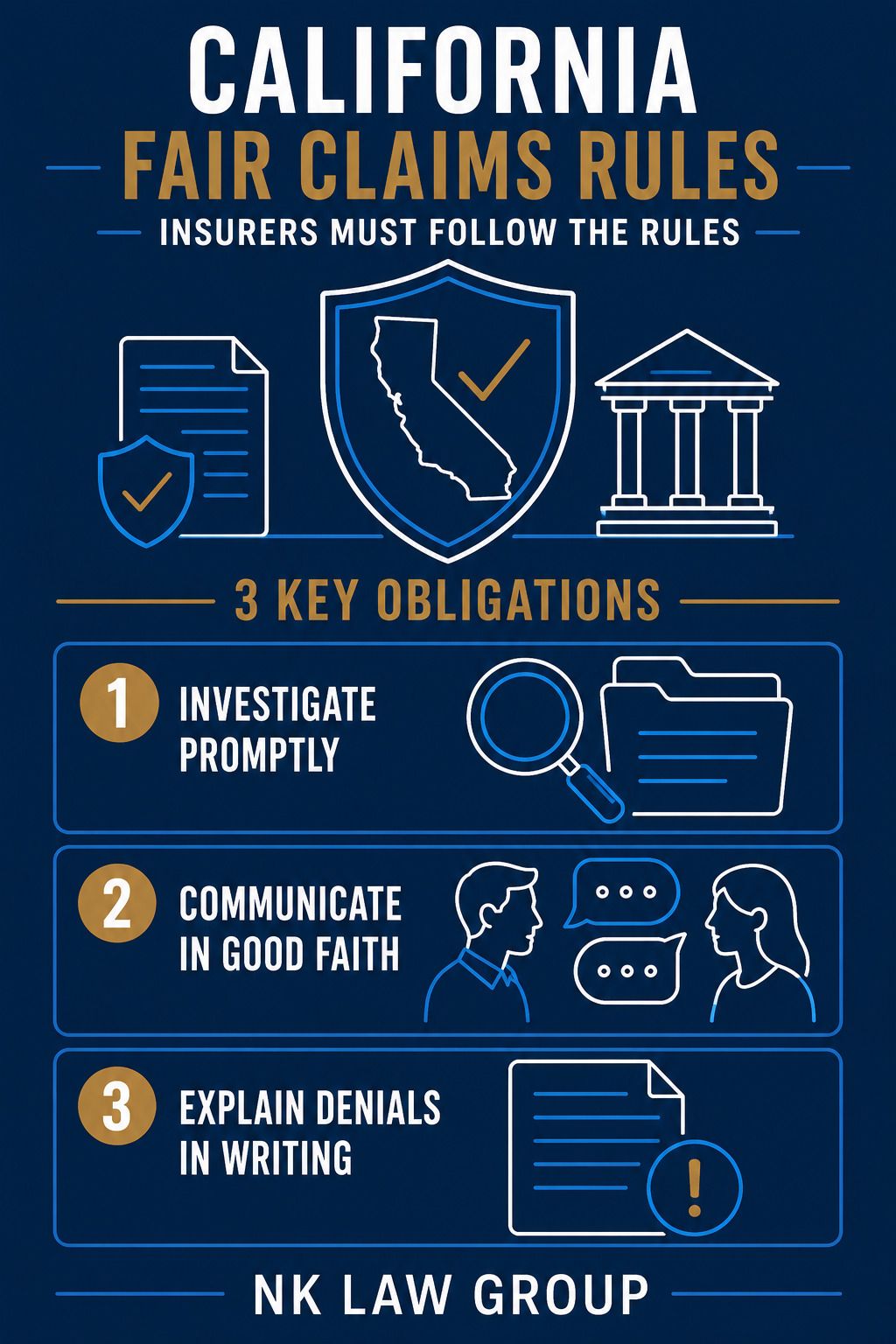
California law sets strict rules for how insurers must handle claims. The state’s Fair Claims Settlement Practices Regulations require insurers to investigate promptly, communicate in good faith, and provide written explanations for any denial. When an insurer violates these rules, it may be acting in bad faith, which opens the door to additional legal remedies.
What Is Bad Faith Insurance Handling?
Bad faith occurs when an insurer unreasonably denies or delays a valid claim without a legitimate basis. Examples include refusing to investigate properly, misrepresenting policy terms, or making a low settlement offer to pressure you into accepting less than your case is worth. California law allows injury victims to take legal action against insurers who engage in these practices.
A denial is not always bad faith, but it is always worth examining closely. If the reason given does not hold up against the evidence in your case, an attorney can identify whether the insurer crossed a legal line. NK Law Injury & Car Accident Lawyer has a detailed resource on bad faith insurance claims in California that covers how this issue plays out.
Steps to Take After a Claim Denial
Receiving a denial does not mean your case is over. There are concrete actions you can take to challenge the decision and protect your right to compensation. The following steps are a good place to start:
- Request the denial in writing: If you have not already received a written explanation, ask for one. California law requires insurers to explain the basis for any denial.
- Review the denial carefully: Compare the stated reason against your policy and the facts of the accident. Errors or overreaches by the insurer are not uncommon.
- Gather additional evidence: Medical records, police reports, witness statements, and photos can all strengthen a challenge to the denial.
- File an appeal with the insurer: Submitting new evidence or a formal letter of dispute through the insurer’s internal appeals process can sometimes reverse a denial.
- Consult a personal injury attorney: An attorney can evaluate the denial, identify your options, and handle negotiations or litigation on your behalf.
Acting quickly matters, because the clock is still running on your legal deadlines regardless of where things stand with the insurer.
Can You Still File a Lawsuit After a Denial?
Yes. A claim denial from the at-fault driver’s insurer does not prevent you from filing a personal injury lawsuit directly against the at-fault driver. Filing suit is often what moves a stubborn insurer toward a fair resolution, because it signals the case will not simply disappear.
California’s statute of limitations for personal injury claims is generally two years from the date of the accident. Exceptions may apply, including extended deadlines for minors or individuals who were incapacitated, and a shorter window when a government entity is involved. The injury claims statute of limitations in California covers these rules in full.
Should You Accept a Low Offer Instead?
When an insurer does not outright deny a claim, it may respond with a settlement offer far below what your case is worth. Accepting too soon typically means signing away your right to recover anything further, even if your medical costs continue to grow. Understanding when to accept a settlement offer and when to push back is one of the most consequential decisions in any personal injury case.
If the at-fault driver’s insurer refuses to pay altogether, your attorney can explore additional avenues, including your own uninsured or underinsured motorist coverage. You have more options than the insurer wants you to believe.
Contact NK Law Injury & Car Accident Lawyer After an Insurance Claim Denial
NK Law Injury & Car Accident Lawyer is a boutique personal injury firm that takes a limited number of cases so every client receives direct, attentive representation. Naseer Khan, Esq. negotiates personally with insurance companies and has a track record of pushing back against insurers who undervalue legitimate claims. In one case, a client who had nearly accepted an $1,800 settlement ultimately recovered $46,000 after NK Law Injury & Car Accident Lawyer stepped in.
A denial does not mean you are out of options. NK Law Injury & Car Accident Lawyer serves clients throughout California at no upfront cost, and you owe nothing unless we recover for you. Reach out through our online contact form to schedule a free consultation today.

EXPERTLY REVIEWED BY
Naseer Khan, Esq.
June 9 2026
Top-rated personal injury attorney Naseer Khan, Esq. has over a decade of experience advocating for injury victims in California. As an award-winning attorney and a member of the American Association for Justice, Khan has a stellar track record of success and devotion to justice for his clients.