
What to Do When the Other Driver Lies About a Car Accident in California

You did everything right, and now the other driver is lying about what happened. It is one of the most frustrating situations you can face after an accident, and unfortunately, it is more common than most people realize. The good news is that a lie does not automatically hurt your claim, and there are steps you can take to protect yourself.
At NK Law Injury & Car Accident Lawyer, we help injury victims across California navigate exactly these kinds of situations. Attorney Naseer Khan built his career fighting back against the tactics insurance companies and at-fault drivers use to avoid accountability, and our firm is committed to making sure the truth comes out. If you are dealing with a dishonest driver after a collision, you do not have to face it alone. If you have been hurt in a car accident, the first thing to understand is why the other driver might be lying and what that means for your case. A driver may deny fault to avoid liability, to protect their insurance rates, or simply out of panic in the moments after a crash. Whatever the reason, their version of events is not the final word.
What Kinds of Lies Do Drivers Tell After Accidents?
Dishonesty after an accident can take many forms, and knowing what to expect can help you respond effectively. Some drivers claim they were not speeding when evidence says otherwise. Others say you ran a red light when witnesses saw the opposite. Some change their story between the scene and the insurance investigation, hoping the inconsistencies go unnoticed.
According to the Coalition Against Insurance Fraud, more than one in five drivers has admitted to lying to their insurer at some point. While not every false statement rises to the level of fraud, any dishonesty that shifts blame away from the at-fault driver can directly affect your ability to recover compensation.
How Evidence Can Counter a False Account
The truth has a way of surfacing when you know where to look. Evidence collected after an accident can directly contradict what the other driver says and establish what actually occurred. Some of the most powerful forms of evidence include:
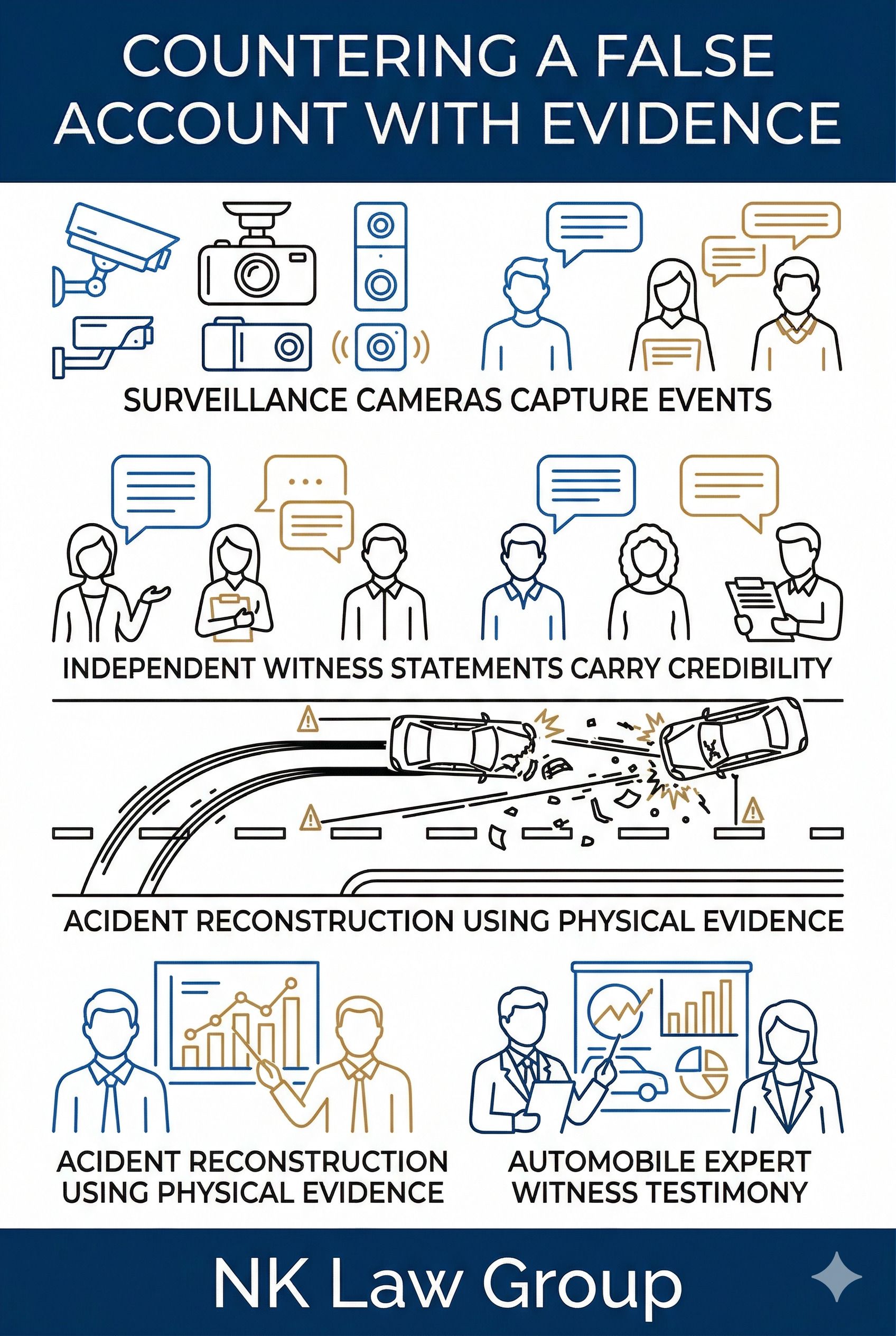
- Surveillance footage: Cameras from nearby businesses, traffic lights, or dash cams and doorbell devices can capture the exact sequence of events
- Witness statements: Independent bystanders who saw the crash carry significant credibility with insurance adjusters and juries
- Accident reconstruction: A qualified analyst can recreate the collision using physical evidence such as skid marks, debris patterns, and vehicle damage
- Automobile expert witnesses: These professionals can assess the mechanics of the crash and offer testimony about speed, impact angles, and vehicle behavior
The more documentation you gather at the scene, the stronger your position will be if the other driver tries to rewrite the story. Take photos, get the names and contact information of anyone who witnessed the crash, and avoid discussing the accident in detail with the other driver.
How California’s Fault Laws Affect Your Case
California follows a pure comparative negligence rule, which means your compensation can be reduced by your percentage of fault. If a jury finds you 20% responsible, you would recover 80% of your total damages. This structure is important to understand because a lying driver may try to inflate your share of the blame to reduce what they owe you.
This is also why the other driver’s dishonesty is not just a personal frustration. It is a legal strategy. If their false account shifts even partial blame onto you, it can reduce your recovery. If you discover the fault driver’s insurance won’t pay, or their insurer is disputing liability altogether, having an attorney in your corner becomes all the more important. An attorney can challenge misrepresentations directly during the claims process and, if needed, in court.
Should You Accept a Settlement When Fault Is Disputed?
When liability is in question, insurance companies sometimes move quickly to offer a settlement. The offer may seem reasonable, but accepting it too soon can leave you with less than you deserve, especially if you have not yet seen the full picture of your losses. Before you accept any settlement offer, it is worth having an attorney evaluate whether it reflects the true value of your claim.
It is also worth noting that in California, the statute of limitations for filing a personal injury lawsuit is generally 2 years from the date of the accident under California Code of Civil Procedure section 335.1. However, exceptions may apply. The deadline can be extended in cases involving a minor, a defendant who has left the state, or situations where the injury was not discovered right away. An attorney can help you determine which timeline applies to your case.
Contact NK Law Injury & Car Accident Lawyer After a Car Accident in California
NK Law Injury & Car Accident Lawyer takes a boutique approach to personal injury law; we limit the number of cases we take on so every client receives the attention their case deserves. No case is too small. Whether your accident involved a reckless driver and a clear-cut dispute or a more complicated set of circumstances, we fight to make sure you are entitled to compensation for all of your losses, including medical expenses, lost wages, and pain and suffering.
If the other driver is lying about what happened, do not wait to get help. NK Law Injury & Car Accident Lawyer charges nothing up front and only gets paid when you do. To get started, fill out our contact form, and we will be in touch to discuss your options.

EXPERTLY REVIEWED BY
Naseer Khan, Esq.
May 8 2026
Top-rated personal injury attorney Naseer Khan, Esq. has over a decade of experience advocating for injury victims in California. As an award-winning attorney and a member of the American Association for Justice, Khan has a stellar track record of success and devotion to justice for his clients.